Survive Your Ideas lets any word become a hazard — tsunami, dinosaur, nuke, or tacos are just the documented examples. Because one random player types a word every round and words stack round after round, choosing words with broad, map-wide reach gives you a meaningful edge over words with limited scope. This guide covers the documented word examples, how the Index tracks what you have typed, what affects a word's impact, and how to test and suggest new additions.
Survive Your Ideas Words and Effects: Browse the Documented List
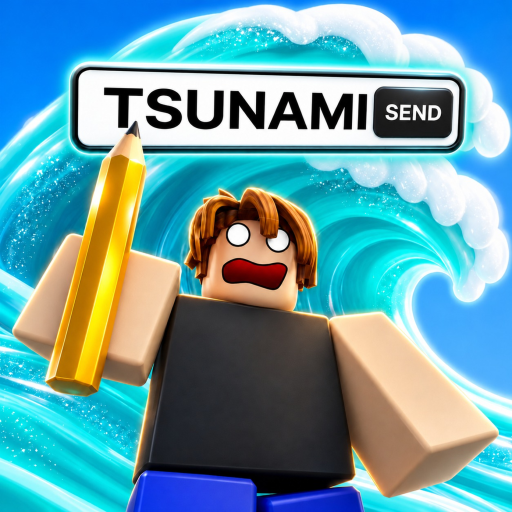
The game's official description names four words as examples of what players can type: tsunami, dinosaur, nuke, and tacos. Each one points to a different category of effect. Tsunami and nuke suggest area-wide, map-spanning hazards — the kind that threaten everyone on the server simultaneously. Dinosaur suggests a creature-based threat that presumably moves through the arena. Tacos is the odd entry out, sitting in a novelty or food category whose practical danger is less obvious from the name alone.
Those four examples are the only words confirmed in official materials. The actual word pool is open — the description states that any word can be typed and will come to life, so the documented four are illustrative, not exhaustive. What they do confirm is that words are not equal: a map-wide environmental hazard like a tsunami behaves nothing like a roaming creature or a food item.
The practical choice each round is therefore about category and reach, not just creativity. When it is your turn, a word that generates a broad, hard-to-avoid effect adds pressure to every remaining player. A word with limited or localised impact may barely change the arena state at all, especially as earlier words continue to stack on top of it.
Tsunami — environmental, map-wide wave hazard
Nuke — environmental, area-wide explosive hazard
Dinosaur — creature-based, mobile threat
Tacos — novelty or food category; practical danger unconfirmed in official sources
Survive Your Ideas best words Quick Reference & Progression Overview
Progression Stage
Core Objective
Key Mechanic
Player Priority
Early Game Setup
Learn Survive Your Ideas core loop
Initial resource & starter unlock
Complete tutorial loop before spending currency
Mid Game Scaling
Unlock higher multiplier tiers
Loadout / upgrade synergy
Focus on repeatable milestones and efficiency
Endgame & Updates
Bosses, events, and new worlds
High-tier drops & patch preparation
Track official update logs and optimize builds
How Long Do Word Effects Last, and Does Every Word Have One?
According to the official description, every word a selected player types comes to life that round and then stacks with words from previous rounds — meaning effects accumulate rather than reset. The practical implication is that nothing clears the arena between rounds: a tsunami from round two is still part of the environment when a nuke lands in round five.
What the official materials do not document is the per-word duration. There is no published data on whether a given word's hazard persists for a fixed number of rounds, fades over time, or remains until the match ends. Until that information is confirmed, the safest assumption is that any effect you introduce could last the full game.
This uncertainty shapes how you should choose words. If effects are indefinite, a word with broad, map-wide reach gives compounding value each round, whereas a word with a narrow or localised effect contributes less as the arena grows more chaotic. Choosing words whose consequences you are comfortable living with for the rest of the match is a reasonable baseline strategy.
1
Check Current Survive Your Ideas best words Requirements
Review the active mechanics and prerequisites inside Survive Your Ideas before committing resources.
2
Complete the Core Progression Loop
Follow the primary objective sequence to unlock the next multiplier, zone, or equipment slot.
3
Verify Post-Update Changes
Re-check the comparison table and official Survive Your Ideas patch notes whenever a new update drops.
What Is the Index, and How Can You Check an Entry?
The Index is the game's built-in record of every word you have typed across your sessions — full details on its entries, how completion works, and what you unlock are covered on the dedicated Index page.
Tracking your typed words matters because the Index reflects your personal history with the word pool. Knowing which words you have already submitted helps you make deliberate choices in future rounds rather than repeating low-impact picks by accident.
Because words stack round after round and the arena state grows more unpredictable over time, players who reference the Index can spot gaps in their experience and intentionally test word categories they have not tried yet — a practical step toward both completion and improving round-to-round decision-making.
Why a Word May Not Do What You Expected
Not every word typed in Survive Your Ideas produces a visible effect. The game recognizes certain words and transforms them into hazards — tsunami spawns water across the map, dinosaur summons a creature, nuke detonates an explosion, tacos drop food items — but unrecognized words may fail silently or behave unpredictably. If you type a word and see nothing happen, the game likely does not have an entry for it yet, or the word requires exact spelling or capitalization to trigger.
The effect itself is generated from the word's meaning or association, not from player input alone. Tsunami creates a water-based hazard because of what the word represents, not because you hoped for water. This means the outcome is somewhat deterministic — the same word should produce the same hazard type in isolation — but the visual or mechanical result depends on the current arena state. If multiple hazards are already active or stacked from previous rounds, a new word's effect interacts with those existing hazards in ways that may surprise you.
Stacking is the core reason words behave differently round to round. Because every typed word persists or compounds with earlier rounds, the arena grows more chaotic as the game progresses. A tsunami in round one floods a clear map; a tsunami in round five floods a map already occupied by dinosaur spawns, nuke debris, and lingering taco drops. The word itself does not change, but the outcome shifts based on what is already there. Testing the same word across different match states reveals this dynamic: early-round words anchor the hazard layer, while late-round words must navigate an increasingly crowded and unpredictable environment.
Understanding these three variables — recognition, effect origin, and stacking context — helps you predict and adapt. Choose words you expect the game to recognize, remember that the effect flows from the word's real-world meaning, and accept that the same word will feel different depending on when in the match it appears and what chaos already surrounds it.
Are the Most-Used Words the Best Words?
Popular does not always mean effective. The four documented examples — tsunami, dinosaur, nuke, and tacos — show a clear spectrum. Tsunami and nuke are catastrophic, map-wide hazards that threaten every player and stack powerfully across rounds. Dinosaur introduces a roaming threat with unpredictable pathing but limited simultaneous coverage. Tacos, while memorable, likely affect a smaller area or fewer players at once. If your goal is to maximize chaos and eliminate opponents quickly, words with broad reach and persistent danger outperform novelty picks that sound fun but lack scale.
The best word depends on the arena state when you type it. Early rounds reward words that spread across the map and force movement — tsunami or nuke set the tone and constrain safe zones for every subsequent hazard. Mid-to-late rounds benefit from words that interact with the existing stack: adding a second tsunami to a dinosaur-filled arena compounds the challenge, while a third tacos entry may add clutter without meaningfully changing survival odds. Predictability also matters; nuke and tsunami have clear, immediate effects, whereas words outside the documented set may generate weaker or inconsistent results until the community identifies their behavior through repeated testing.
Common questions
Frequently Asked Questions
How long do word effects last in Survive Your Ideas?
The official game description confirms that words stack round after round rather than expiring after a single round — chaos accumulates until one player is left standing. Per-word duration figures have not been publicly documented, so plan around effects persisting and compounding rather than clearing between rounds.
Does every word in Survive Your Ideas have its own effect?
The game's premise is that any word you type comes to life, with tsunami, dinosaur, nuke, and tacos cited as official examples spanning floods, creature spawns, explosions, and food-based chaos. Whether every conceivable word has a mapped effect or falls back to a default has not been confirmed by the developer.
What is the Index in Survive Your Ideas?
The Index is an in-game collection that records words you have typed across rounds. The dedicated Index page on this site covers how entries are logged, how to check your progress, and what completion looks like — head there for the full breakdown.
Why did my word not do what I expected?
Effect output depends on how the game interprets the word you submitted. Spelling, synonyms, and the current arena state from stacked previous rounds all influence what happens. If a word went unrecognised or produced a minimal effect, try a clearer, more concrete noun — the documented examples (tsunami, dinosaur, nuke) are all single unambiguous nouns.
Are the most-used words the best words in Survive Your Ideas?
Popular words are not always the most effective. A word with map-wide reach — like tsunami or nuke — threatens every remaining player simultaneously. A narrower effect may feel satisfying but offers less competitive value as player count drops and the arena fills with stacked hazards from earlier rounds.
 Survive Your Ideas